Compare
Clearthesis vs Morningstar
Morningstar is the long-standing name in independent research for long-term investors: analyst-written fair values, economic moat ratings and star ratings, plus strong fund and portfolio tools. Clearthesis shares the same long-term mindset, and writes a full plain-English thesis on each stock, with every assumption shown.
Facts about Morningstar checked November 26, 2026
The short answer
Choose Morningstar if
You want analyst-written research from a 40-year-old firm, strong fund ratings and portfolio tools, and you are comfortable with a more technical style.
Choose Clearthesis if
You want the same kind of long-term analysis explained in plain English, with every valuation assumption visible, and the ability to ask follow-up questions.
How Clearthesis compares
Morningstar and Clearthesis ask the same questions: is there a moat, and what is the business worth? The difference is how the answer is written and how much of the working you can see.
What you get
Clearthesis
One full written investment thesis per stock
Morningstar
Analyst reports, star ratings, fair values and moat ratings, plus fund research
Time horizon
Clearthesis
Long-term: years
Morningstar
Long-term: years
Moat rating
Clearthesis
Yes, with the evidence for it
Morningstar
Yes, wide, narrow or none, set by a moat committee
What the stock is worth
Clearthesis
Fair value with every assumption shown, and where it could be in five years
Morningstar
Analyst fair value from a cash flow model
Plain English
Clearthesis
Yes, every finance term explained as it comes up
Morningstar
Professional and fairly technical
Ask follow-up questions
Clearthesis
Yes, ask the AI analyst anything about the stock
Morningstar
Not a core feature for individual investors
Who writes it
Clearthesis
AI, built from the company's filings, with sources shown
Morningstar
Human analysts for about 1,500 stocks; a model for the rest
Funds and portfolio tools
Clearthesis
Not the focus
Morningstar
Yes, among the best fund ratings and portfolio analysis
Price
Clearthesis
Free to read every thesis, with one valuation a month. Pro is $19 a month or $149 a year
Morningstar
About $249 a year or $34.95 a month, often $199 for the first year
An honest look at Morningstar Investor
What it does well
Independent and long-term
Morningstar has rated stocks and funds for long-term investors since 1984, and its analysts are not paid by the companies they cover.
It invented the moat rating
Its wide, narrow or none moat ratings are a widely used shorthand for how protected a business is.
Funds and portfolios
Fund ratings and Portfolio X-Ray, which shows what you really own across all your funds, are hard to find elsewhere.
What to watch out for
Written for people who already know the terms
Reports are thorough but technical. If phrases like "cost of capital" or "excess returns" lose you, they can be slow going.
Analyst reports on a limited set
Human analysts cover roughly 1,500 stocks. The rest get ratings from a model trained on those analysts.
Not much "what to do"
Reviewers note there is little direct guidance on what to buy, and the tools can feel clunky, especially on mobile.
Billing complaints
Its Trustpilot reviews are low, mostly about renewals and cancelling. Note the renewal date.
Is Morningstar Investor worth it?
For self-directed long-term investors, especially ones who also hold funds, it often is. The research is independent, the fair values and moat ratings are respected, and the portfolio tools are excellent.
It is less of a fit if you are still learning. The writing assumes you know the language of finance, and you cannot ask it to explain a point you did not follow.
Clearthesis is built for the same long-term investor, with every term explained in plain English, every valuation assumption shown, and an AI analyst you can question.
What Clearthesis gives you
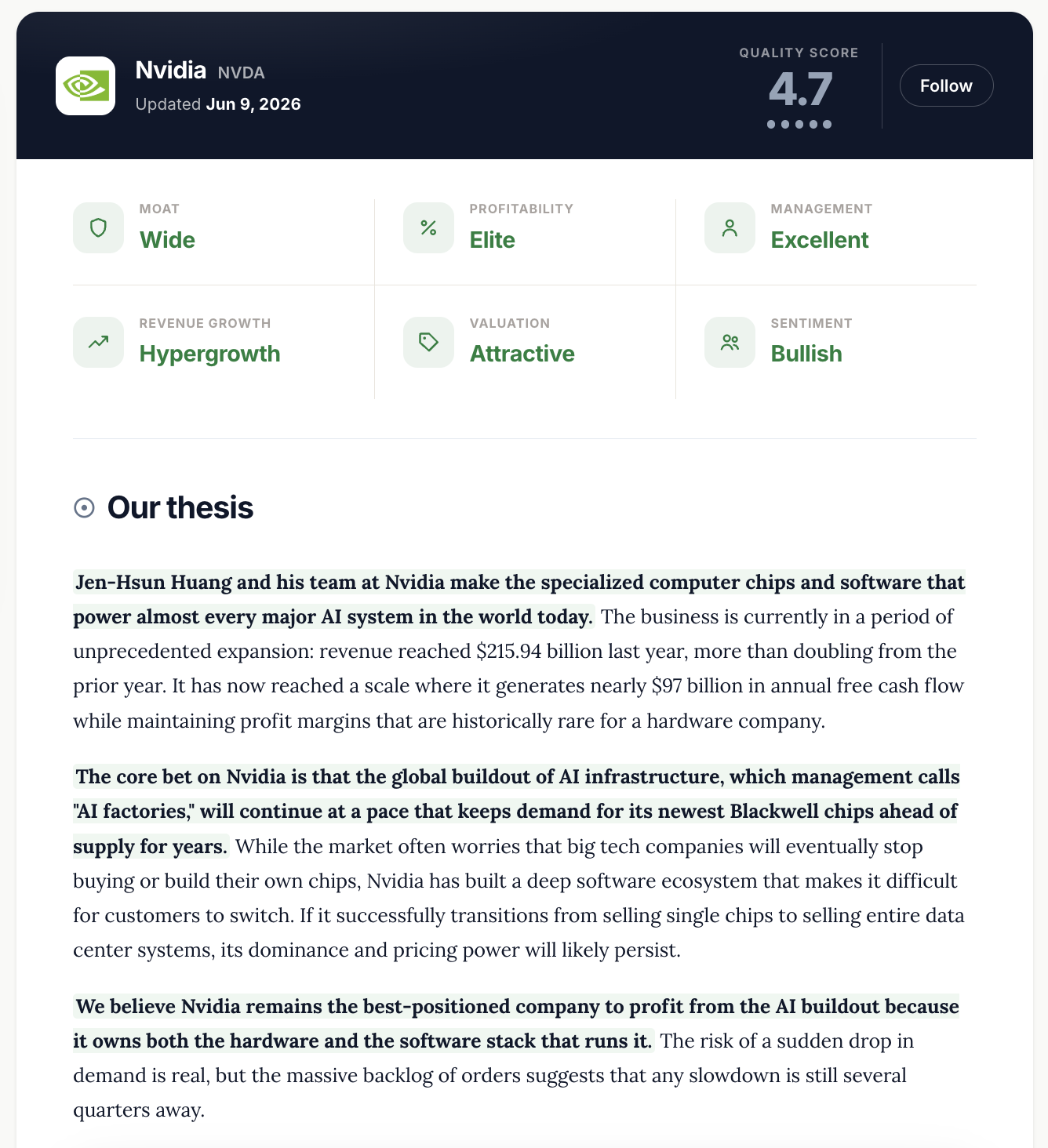
A full investment thesis on any stock you are looking at: how the business makes money, what keeps rivals out, the risks, a fair value with every assumption shown, and a clear verdict.
- How it makes money
- Competitive moat
- Financial health
- Management
- Risks
- Fair value
- Five-year outlook
- Buy, watch or avoid
Common questions
Is Morningstar Investor worth it?
For long-term investors who want independent analyst research and fund tools, usually yes, at about $249 a year. If you want the same long-term analysis in plain English with every assumption shown, Clearthesis is an alternative, free to read.
How much does Morningstar Investor cost?
About $249 a year or $34.95 a month, with the first year often offered at $199 and a short free trial. Check morningstar.com for the current price.
What is a Morningstar economic moat rating?
Morningstar's judgment of how well a company can keep competitors away for years: wide (likely 20 years or more), narrow (likely 10 years or more) or none.
Is Morningstar legit?
Yes. Morningstar was founded in 1984 in Chicago and is a public company. It is one of the most established independent research firms.
What is a good Morningstar alternative?
Clearthesis covers 500+ US stocks with a plain-English thesis, a moat rating, a fair value with every assumption shown, and a verdict, free to read. Simply Wall St is a more visual, cheaper option.
Start with a stock you care about
It is free to start. Read the full thesis on any of 500+ US stocks.
More comparisons
Facts about Morningstar come from public sources and were checked on November 26, 2026. Prices and features change, so check Morningstar's own site before you buy. Spotted something out of date? Tell us and we will fix it.
Sources: Morningstar Investor, Morningstar moat ratings, Wall Street Survivor: Morningstar Investor review
Clearthesis is not affiliated with Morningstar. Clearthesis is research, not investment advice. It is written by AI and it can be wrong.